
AI-Powered Summary
- Contactless payment, also known as tap-to-pay, is a secure and touch-free method using NFC and RFID technologies for quick transactions without requiring PINs or signatures for amounts up to ₹5,000 in India.
- The process involves initializing the payment by bringing a device close to an NFC-enabled POS terminal, followed by secure communication, encryption, authorization, and confirmation within seconds.
- Types of contactless payments in India include NFC-enabled cards, mobile wallets and UPI apps, wearable devices like smartwatches, and QR code-based UPI payments.
- Benefits of contactless payments include faster transactions, improved hygiene, and enhanced security through encryption and tokenization.
- Risks include dependency on devices and technology, potential misuse of lost cards, and limited acceptance in some areas.
- Businesses can adopt contactless payments by using NFC-enabled POS terminals and reliable payment gateways like PayU.
Contactless payment, also known as tap-to-pay, is a secure, touch-free way for customers to pay using a card, phone, or wearable device. It uses NFC (Near-Field Communication) and RFID (Radio Frequency Identification) technology to let a payment device communicate with a point-of-sale (POS) terminal without inserting a card, entering a PIN, or signing a receipt for smaller transactions.
Contactless payment has grown quickly in India because it is fast, hygienic, and convenient for both customers and businesses. This guide covers what contactless payment means, how it works, its types, the RBI transaction limit, its advantages and risks, and how a business can start accepting contactless payments.
Table of Contents
What is contactless payment?
Contactless payment is a payment method where a customer taps or holds their card, smartphone, or wearable device near an NFC-enabled POS terminal to complete a transaction. It removes the need to swipe or insert a card, enter a PIN for small amounts, or provide a signature.
When a customer makes a contactless payment, data is exchanged between the card or device and the POS terminal within a range of about four centimetres. This short range helps prevent accidental card reads and reduces the risk of fraudulent transactions.
A contactless payment gateway does not require customers or businesses to handle cash or come into physical contact with a shared payment device, which is part of why the method gained popularity for hygiene reasons as well as speed.
Contactless Payment Limit in India: RBI Rules Explained
As per Reserve Bank of India (RBI) guidelines, the current contactless payment limit is Rs. 5,000 per transaction. Customers can make a payment up to this amount without entering a PIN. For transactions above Rs. 5,000, the card issuer requires PIN entry to complete the payment.
This limit applies to contactless (NFC) card and device transactions and is set by the RBI as a fraud-control measure, not by individual merchants. Card issuers may allow customers to set a lower personal limit or switch off contactless payments entirely through their bank’s app for added control.
Availability of contactless payment and its exact limit may vary by card issuer, card network, and payment mode. Businesses and customers should verify current limits with their bank or card provider.
How Does Contactless Payment Work?
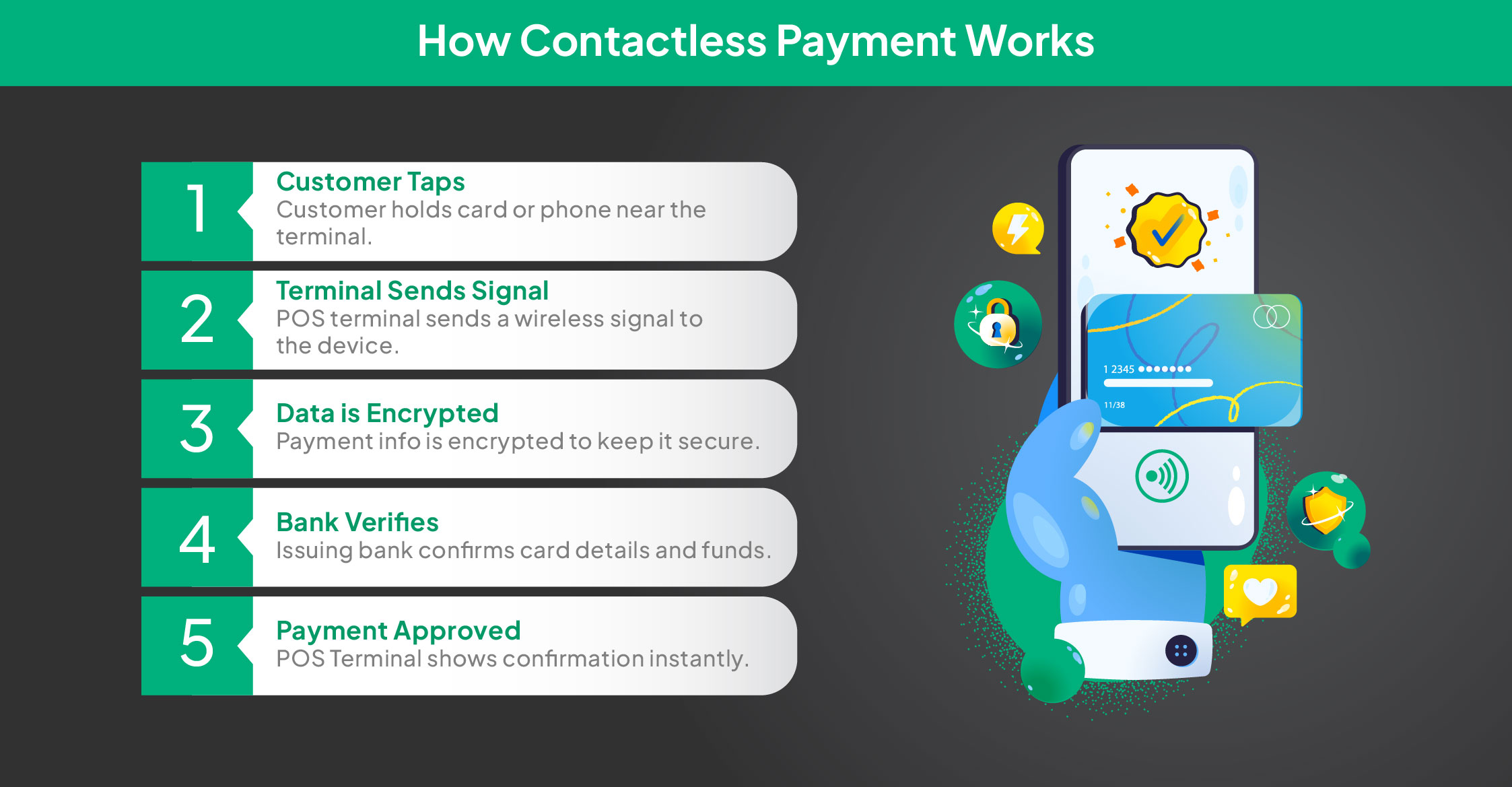
Contactless payments use NFC to let two devices, the customer’s payment device and the merchant’s POS terminal, communicate when they are held close together. Here is a step-by-step look at how a tap-to-pay transaction is processed.
- Initialisation
The customer holds their contactless-enabled debit or credit card, smartphone, or any other wearable device close to the NFC-enabled point of sale (POS) terminal.
- Communication
The POS terminal sends a radio frequency signal that is detected by the NFC chip in the customer’s payment device, which initiates the payment.
- Encryption and Tokenization
The payment information is transmitted securely using encryption. This process typically involves tokenization, where a unique token is generated for that specific transaction instead of transmitting the actual card number.
Read more – What Is Tokenization in Payments?
- Authorisation
The payment processor verifies the transaction details and checks if there are enough funds available to complete the transaction.
- Confirmation
Once the payment is authorised, the transaction is completed and the POS terminal displays a confirmation message. The entire process usually takes only a few seconds, making it faster than a traditional card swipe or chip transaction.
What Are the Types of Contactless Payments?
Contactless payment is not a single technology. It covers several methods that businesses in India commonly encounter:
1. Contactless Credit and Debit Cards
Many Indian banks now issue contactless-enabled debit and credit cards. A contactless transaction on a debit card or a contactless transaction on a credit card works the same way: the card contains a chip that supports NFC, and tapping it on a POS terminal completes the payment instantly for amounts within the RBI limit. These cards can be identified by the wireless signal symbol printed on them. Popular contactless card networks include Visa payWave and Mastercard PayPass.
2. Mobile Wallets and UPI Apps
Smartphones make contactless payment easier by removing the need to carry a physical card. Popular UPI and mobile wallet apps allow customers to pay using UPI or card-based tap-to-pay, often through the phone’s built-in NFC capability. The customer simply unlocks their phone, holds it near the terminal, and completes a touch-free payment.
3. Wearables: Smartwatches and NFC Rings
Wearable devices, including smartwatches and NFC-enabled rings, can securely store card details once linked to a bank account or card. Popular examples include the Apple Watch, Samsung Galaxy Watch, and NFC payment rings. These devices use the same NFC technology as cards and phones to process payments. Wearables are still an emerging category in India but are expected to grow as contactless adoption increases.
4. QR Code-Based Contactless Payments (UPI)
In India, QR code payments are one of the most widely used forms of contactless payment. With UPI, a customer scans a QR code displayed by the merchant and approves the payment in their banking or UPI app, with no physical contact involved. This form of touch-free payment is especially popular with small businesses and street vendors because it does not require an expensive POS machine.
Advantages of Contactless Payments
For customers and businesses alike, contactless payment offers several practical benefits:
- Faster checkout: transactions are completed in seconds, which helps reduce queues at busy checkout counters.
- Improved hygiene: customers avoid handling cash or touching a shared card machine or PIN pad for small transactions.
- Reduced cash handling: businesses spend less time counting, storing, and depositing cash.
- Better customer experience: a fast, simple checkout can support conversion and repeat visits.
- Built-in security layer: tokenization means the customer’s actual card number is not transmitted during the transaction.
For businesses evaluating a contactless payment gateway, these benefits generally translate into fewer checkout delays and a smoother payment experience for customers, though actual impact depends on the business type, ticket size, and customer base.
Is Contactless Payment Safe? Security Features to Know
Contactless payment is generally considered safe when used within the RBI’s transaction limit and fraud-control framework. A few features support this:
- Tokenization: each transaction uses a unique token instead of the card’s actual number, so a captured tap cannot easily be reused.
- Short read range: the four-centimetre communication range makes it difficult for a stray or accidental scan to occur.
- Transaction limit: the RBI’s Rs. 5,000 cap on PIN-free transactions limits potential losses if a card is lost or stolen.
- PIN requirement above the limit: any transaction over Rs. 5,000 still requires PIN verification, adding a manual check for larger payments.
As with any payment method, customers should report a lost or stolen card immediately, since small transactions may be possible before the card is blocked. Businesses accepting contactless payment should keep their POS software and terminals updated, and should verify current security requirements with their acquiring bank or payment gateway provider, since implementation details can vary.
Disadvantages and Risks of Contactless Payments
Contactless payment is convenient, but a few limitations are worth knowing:
- Transaction limits: payments above the contactless payment limit require PIN verification, which can interrupt checkout flow.
- Device dependency: phone-based and wearable payments need battery power and, in some cases, network access.
- Lost card risk: if a contactless card is lost, small payments may be possible before the issuer blocks it.
- Uneven acceptance: some smaller towns and businesses still rely more on cash or standard card transactions.
- Terminal dependency: the merchant’s POS terminal must support contactless payment for tap transactions to work at all.
How to Accept Contactless Payments as a Merchant
Businesses that want to accept contactless payments generally need the following:
- An NFC-enabled POS terminal, or a payment gateway and checkout stack that supports contactless card payments and UPI QR codes.
- A tie-up with an acquiring bank or a payment gateway provider that supports contactless and UPI payment modes.
- For online or app-based checkout, integration with a payment gateway that supports the payment modes relevant to the business, including cards, UPI, and wallets.
- Updated POS software and hardware that can process NFC and QR-based transactions securely.
For businesses that also sell online or want a single setup to manage cards, UPI, wallets, and other payment modes together, a payment gateway like PayU can help manage checkout, reconciliation, and settlement across payment modes from one dashboard.
Availability of specific payment modes and features may vary by merchant category, payment mode, and provider approval. Businesses should verify current pricing, eligibility, and setup requirements before implementation.
Conclusion
The rise of contactless payment is changing how businesses and customers transact in India. From cards and smartphones to wearables and QR codes, paying without a physical card swipe has become a standard part of everyday transactions.
The main advantages are faster checkout, improved hygiene, and a built-in layer of transaction security through tokenization and RBI-mandated limits. For businesses, understanding the contactless payment limit, the security features involved, and what is needed to accept these payments makes it easier to offer a modern, reliable checkout experience.
As digital payments continue to grow in India, adopting a reliable contactless payment gateway is becoming a practical step for businesses that want to keep up with how customers prefer to pay.
FAQs
Contactless payment is a method where a customer taps their card, phone, or wearable device on a POS terminal to complete a payment without inserting the card or, for smaller amounts, entering a PIN.
As per RBI guidelines, the contactless payment limit in India is Rs. 5,000 per transaction without a PIN. Transactions above this amount require PIN verification.
Yes. Contactless payment uses encryption, tokenization, and RBI-mandated transaction limits to help keep payments secure. As with any payment method, customers should report a lost card promptly.
Common types include contactless debit and credit cards, mobile wallets and UPI apps, NFC-enabled wearables, and QR code-based UPI payments.
Look for the wireless signal symbol printed on the card. This indicates that the card supports contactless (NFC) payment.
A business needs an NFC-enabled POS terminal or a payment gateway that supports contactless card payments and UPI QR codes, along with a tie-up with an acquiring bank or payment gateway provider.
Most banks do not charge customers extra for using contactless payment, though standard transaction charges may apply depending on the payment mode and provider. Businesses should verify current charges with their bank or payment gateway.
Both work the same way technically, using NFC to tap and pay. The difference is in how the payment is settled: a contactless debit card transaction draws from the linked bank account, while a contactless credit card transaction draws on the available credit limit. Both are subject to the same RBI contactless transaction limit.