
AI-Powered Summary
- India is rapidly becoming one of the largest outbound travel markets, with travelers shifting to independent, international, and digital-first bookings.
- The booking journey has shortened significantly, making the payment step critical as even minor friction can lead to trust issues and drop-offs.
- Indian consumers prefer UPI as their primary payment method, bypassing the traditional card-first phase, which global platforms often fail to accommodate.
- Global travel platforms face challenges in localizing payments due to the need for UPI integration, domestic acquiring networks, and regulatory compliance.
- Indian travelers expect seamless checkout experiences with INR pricing, familiar payment methods, and instant confirmations to avoid hesitation.
- PayU simplifies cross-border payments for India by offering solutions like T+3 settlements, foreign currency support, and API-driven integration to enhance conversion rates.
The ₹1,20,000 Problem Most Teams Don’t See
Someone in Mumbai is booking a Europe trip.
They’ve picked the destination, compared platforms, shortlisted stays. This isn’t browsing anymore, they’re ready to pay.
They hit Book Now.
And then something feels… off.
- The price shows up in USD
- Their card doesn’t go through on the first try
- There’s no UPI option
- The flow feels unfamiliar, slightly uncertain
They pause. Maybe try once more. Then they leave.
What shows up in your dashboard is a failed transaction. What actually happened: You lost a high-intent, high-value booking at the last step.
And this isn’t rare. It’s happening quietly, at scale.
India’s Travel Boom Is Already Playing Out
We tend to talk about India’s outbound travel growth as something that’s coming.
It’s already here.
Estimates from the World Tourism Organization and industry work by McKinsey & Company point to the same direction. India is on track to become one of the largest outbound travel markets globally over the next few years.
But the more interesting shift isn’t just the volume. It’s how people are traveling now.
- More independent travel, less packaged
- More international destinations, not just domestic
- More digital-first decision making
And most importantly: People are moving from “planning trips” to “booking trips” much faster than before.
India isn’t just growing as a travel market. It’s becoming one of the most valuable outbound segments for global platforms.
The Booking Journey Has Shrunk. The Risk Has Increased.
There used to be a gap between intent and payment. That gap is disappearing.
Today, a user might:
- Discover a place on social
- Compare options across a couple of tabs
- Complete the booking in the same session
Often in under 20 minutes.
Because now:
- The consideration window is much shorter
- Expectations from the experience are much higher
- Even small points of friction feel amplified
Which makes the payment step unusually critical.
Users will retry if a payment fails, but not indefinitely. Every failed attempt introduces doubt: Is something wrong with this platform? Will this go through?
And that’s where the real risk lies.
Not just in the failed transaction, but in the loss of trust, pushing the user toward a platform that feels more familiar and reliable.
India Doesn’t Pay the Way Global Systems Expect
This is where most global platforms misread India. They assume payments behave the same way everywhere.
They don’t.
Global payment systems were built for cards. Indian consumers have already moved on. India has effectively skipped the “card-first” phase. It’s now a UPI-first ecosystem. Built by the National Payments Corporation of India, UPI has become the default way to pay for a large share of users.
And not just for small transactions anymore.
People are:
- Paying rent
- Booking flights
- Making large purchases
All through UPI.
So the expectation has quietly shifted. It’s no longer: “What payment options are available?”
It’s: “Can I just pay the way I normally do?”
If the answer is no, hesitation kicks in immediately.
Where the Drop-Off Actually Happens
Most travel platforms don’t see this as a problem.
Traffic is growing. Engagement looks strong. Users are reaching checkout. But conversion tells a different story.
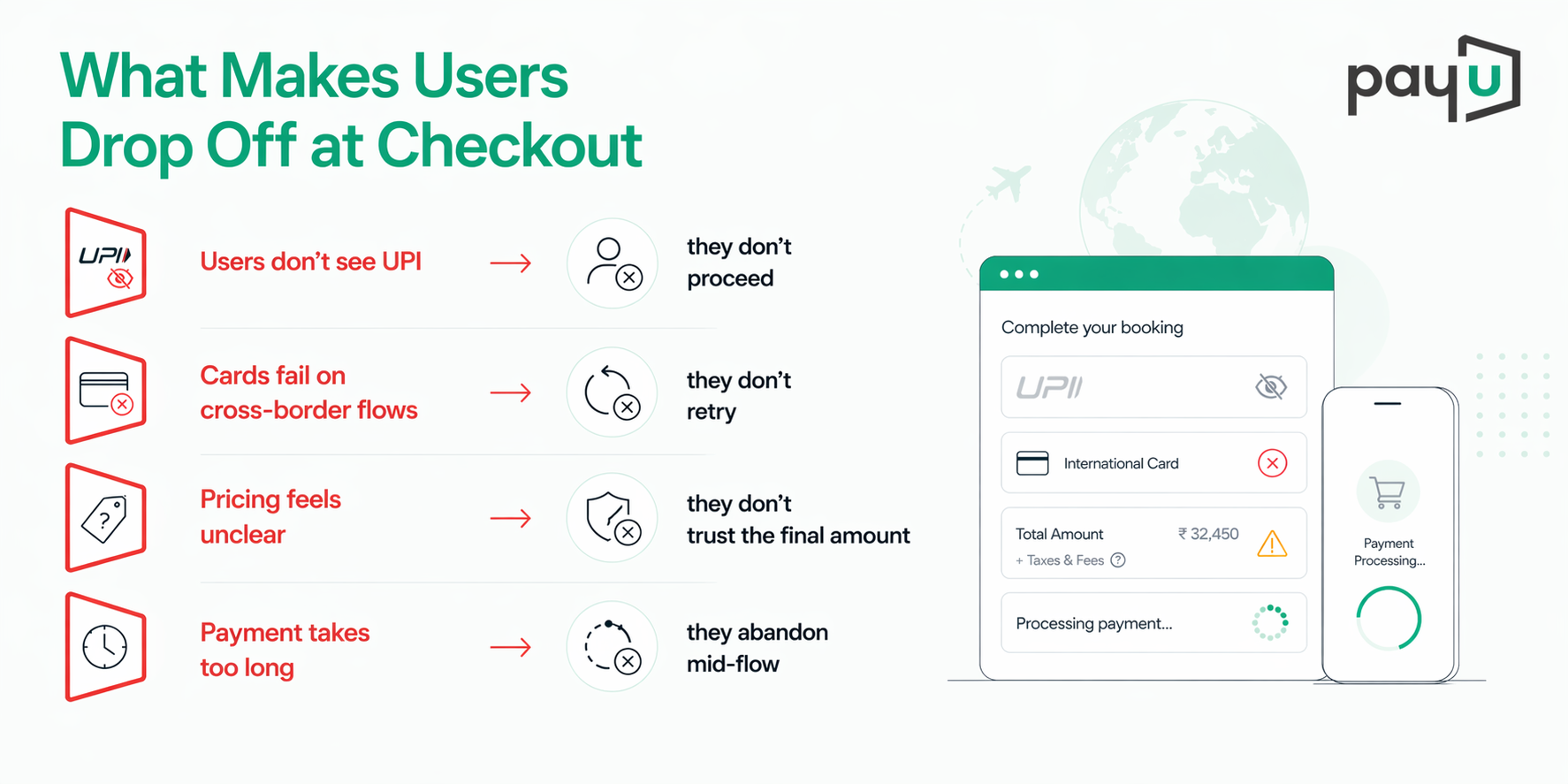
None of this shows up as a dramatic spike. It shows up as:
- Slightly lower conversion
- Slightly higher abandonment
- Slightly worse ROI
At scale, “slightly” becomes significant.
Why “Just Localizing Payments” Isn’t That Simple
On paper, the solution sounds straightforward: localize the payment experience. In practice, it’s far more complex. This is where most global teams underestimate India.
To truly align with how India transacts, businesses need access to:
- Local payment rails like UPI
- Domestic acquiring networks
- A regulatory framework that governs cross-border flows
Traditionally, solving for this meant building locally – setting up entities, managing compliance, and stitching together banking partnerships.
For most global travel companies, that’s a heavy operational lift. So the trade-off becomes clear: Invest deeply in localization, or operate with a conversion gap.
What Indian Travellers Expect at Checkout
Users won’t articulate this, but their behavior makes it obvious.
They expect:
- Prices in INR
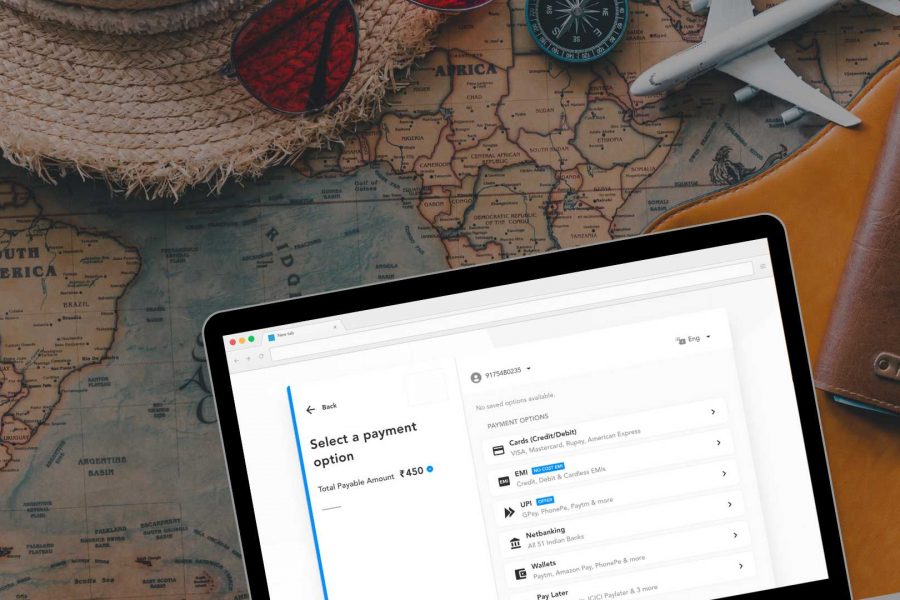
- Familiar payment methods (UPI, cards, NetBanking)
- Fast, reliable transactions
- Immediate confirmation
When this works, the experience feels seamless. When it doesn’t, it introduces hesitation at the worst possible moment i.e. right before payment.
Payments as a Conversion Lever, Not Just Infrastructure
In most industries, payments sit in the background. In travel, they don’t. This is where the right payments infrastructure makes the difference.
Because this is where:
- Intent peaks
- Transaction values are high
- Drop-off risk is highest
Which makes payments directly tied to revenue outcomes, not just transaction enablement.
How PayU Simplifies Cross-Border Payments for India
PayU is built to remove this complexity without requiring global businesses to rebuild their stack for India.
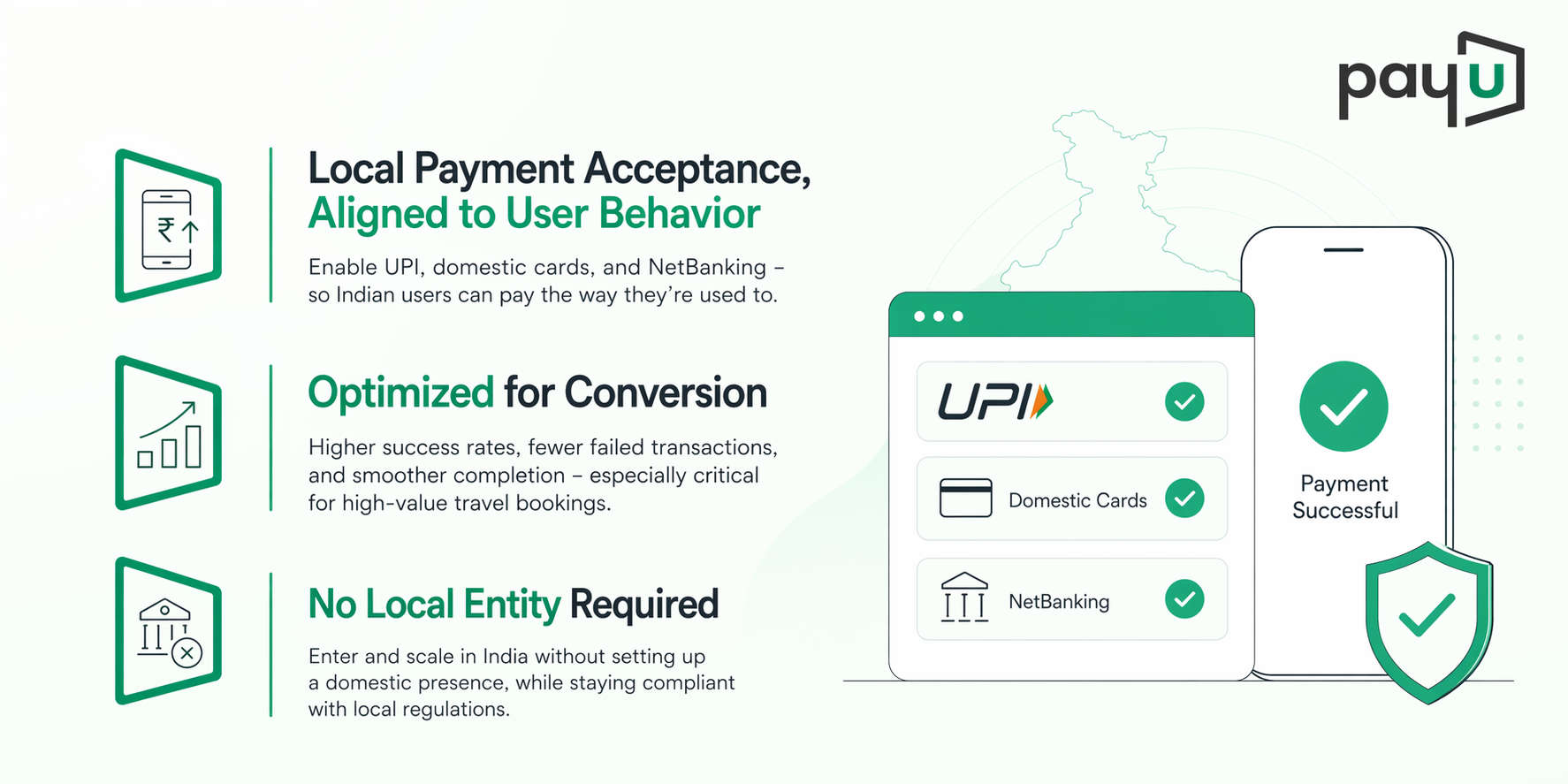
Built for Cross-Border Scale and Compliance
- T+3 settlements
- Foreign currency settlement support
- LRS (Liberalised Remittance Scheme) checks for travel transactions
- 100% API-driven integration
- All designed to simplify operations while improving monetization.
Final Thought: The Booking Isn’t Won at “Book Now”
That click doesn’t guarantee anything.
Not in today’s flow.
The booking is only real when the payment goes through—cleanly, instantly, without doubt.
And for Indian users, that moment is shaped by expectations that are very different from global norms.
You don’t lose the booking because the user changed their mind.
You lose it because the payment didn’t keep up with their expectation.
PayU’s cross-border payments solution is built to close exactly this gap—helping global businesses accept and optimize payments from India without the usual complexity.
If you’re looking to improve how you convert Indian travellers, you can explore more here: https://payu.in/accept-international-payments-from-india/