
AI-Powered Summary
- Contactless payment, also known as tap-to-pay, is a secure and touch-free method using NFC and RFID technologies for quick transactions without requiring PINs or signatures for amounts up to ₹5,000 in India.
- The process involves initializing the payment by bringing a device close to an NFC-enabled POS terminal, followed by secure communication, encryption, authorization, and confirmation within seconds.
- Types of contactless payments in India include NFC-enabled cards, mobile wallets and UPI apps, wearable devices like smartwatches, and QR code-based UPI payments.
- Benefits of contactless payments include faster transactions, improved hygiene, and enhanced security through encryption and tokenization.
- Risks include dependency on devices and technology, potential misuse of lost cards, and limited acceptance in some areas.
- Businesses can adopt contactless payments by using NFC-enabled POS terminals and reliable payment gateways like PayU.
Today, you’ll find contactless payment options everywhere, from supermarkets and restaurants to metro stations and petrol pumps. The convenience and speed are the main reasons more people are choosing tap-to-pay methods instead of traditional card swipes or cash payments.
In this guide, we’ll walk you through the definition of contactless payment, all the types available in India, a step-by-step breakdown of how it works, the contactless payment limit you should know about, the benefits it offers, and the risks to watch out for.
Table of Contents
What is contactless payment?
Contactless payment is also commonly referred to as a tap-to-pay system. As the name suggests, it is essentially a secure and touch-free payment method that enables customers to make payments easily and quickly. It uses NFC (Near-Field Communication) and RFID (Radio Frequency Identification) to establish communication between the business’s acquiring bank and the customer’s payment device.
Since the introduction of the contactless payment system, the technology has gained immense popularity in India. Nowadays, many customers in India prefer contactless transactions as they eliminate the need for customers to provide their debit or credit card to the business owner, enter a PIN (personal identification number), or provide a signature to complete the transaction. Additionally, a contactless payment gateway enables customers to avoid physical contact with the payment processing device or terminal, making it a hygienic, fast, and convenient payment option.
When you make a contactless payment, the data exchange between the contactless card and the POS system is possible within a range of approximately four centimetres. This plays an important role in preventing and minimising the risk of accidental card reading and fraudulent transactions.
Another important thing to note is that, according to the RBI (Reserve Bank of India) guidelines, the current contactless transaction limit is set at Rs. 5,000 per transaction. This means you can make a payment of up to Rs. 5,000 without entering your PIN.
Working of contactless payment systems
Now that you understand what contactless payment is, it is essential to have a clearunderstanding of how the system works. This would also help you assess if the system is suitable for your business.
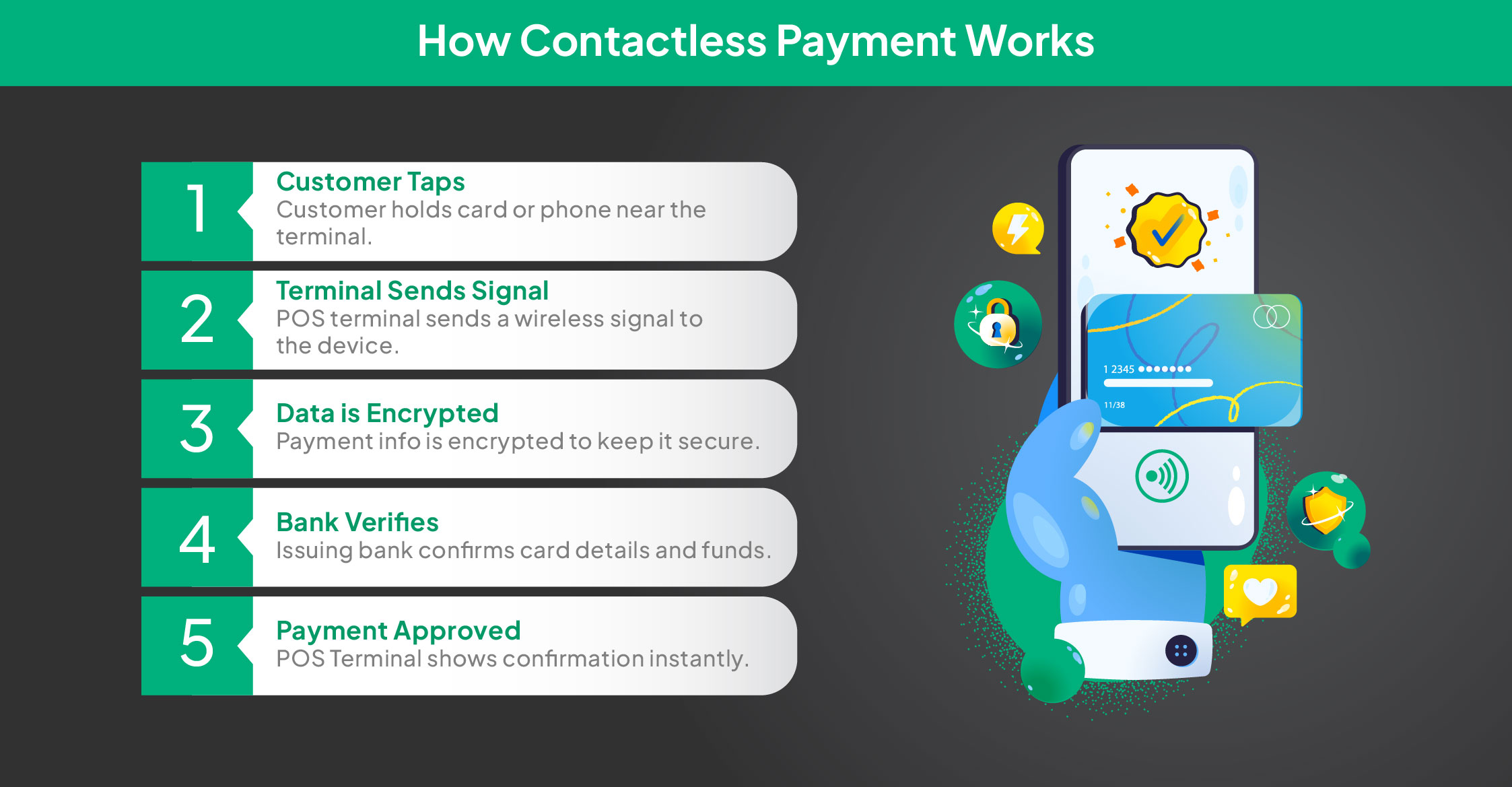
As mentioned before, contactless transactions technology uses NFC. This means that two devices, specifically the customer’s payment device and the merchant’s payment receiving device, communicate with each other when they are in close proximity to each other. Here is a step-by-step process of how contactless transactions, also known as tap and pay transactions, work.
- Initialisation
The customer holds their contactless-enabled debit or credit card, smartphone, or any other wearable device close to the NFC-enabled point of sale (POS) terminal.
- Communication
As soon as the customer places their card, wearable device or smartphone near the POS terminal to tap and pay, the terminal sends out a radio frequency signal, which is detected by the NFC chip in the payment device and the payment is initiated.
- Encryption
Once the payment is initiated, the payment information is securely transmitted using encryption to prevent fraud. This involves tokenization, where a unique token number is generated for each transaction instead of using the card’s details.
Read more – What Is Tokenization in Payments?
- Authorisation
The payment processor verifies the transaction details and checks if there are enough funds available to complete the transaction.
- Confirmation
Once authorised, the transaction is completed, and the POS terminal displays a confirmation message.
Although it may sound tedious, the entire payment process takes only a few seconds to complete. This makes it a significantly faster payment method than the traditional card payment methods.
What Are the Types of Contactless Payments?
Contactless payment isn’t just one thing. It’s an umbrella term for several different technologies and methods. In India, there are four main types you’ll come across:
1. Contactless Credit and Debit Cards
Many banks in India now issue contactless-enabled debit and credit cards. These cards contain a small chip that supports NFC payment or RFID payment technology.
When you tap the card on a POS terminal, the card communicates with the machine and processes the contactless payment instantly.
You can identify such cards by the small wireless symbol printed on them.
Popular contactless card technologies include:
- Visa payWave
- Mastercard PayPass
These cards allow you to tap to pay for small purchases without entering a PIN, depending on the contactless payment limit set by regulators.
2. Mobile Wallets and UPI Apps
Smartphones have made contactless payment even easier. Mobile wallets and UPI apps allow you to pay using your phone instead of carrying cards.
Apps like Google Pay, PhonePe, and Paytm allow users to make payments using UPI or card-based tap-to-pay options. In many cases, your phone uses NFC payment technology to complete the transaction.
This means you simply unlock your phone, hold it near the terminal, and complete a touch free payment.
The biggest advantage is that you don’t need a physical card. Your smartphone becomes your payment device.
3. Wearables: Smartwatches and NFC Rings
Wearable technology is the next step in the evolution of contactless payment.
Devices like smartwatches and NFC-enabled rings can store your card information securely. Once linked to your bank card, they allow you to tap to pay just like a card or phone.
Popular examples include:
- Apple Watch
- Samsung Galaxy Watch
- NFC payment rings
These devices use NFC payment technology to process payments quickly and securely.
Although still emerging in India, wearables are expected to become a popular contactless payment option in the coming years.
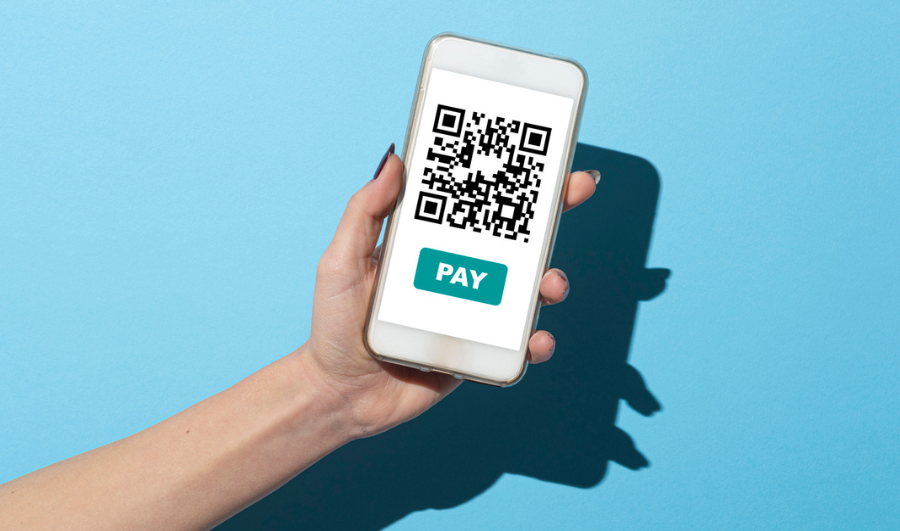
4. QR Code-Based Contactless Payments (UPI)
In India, QR code payments are one of the most widely used contactless payment methods.
With UPI, you simply scan a QR code displayed by the merchant and approve the payment in your app. The entire process happens digitally without any physical contact.
This form of touch free payment is especially popular among small businesses and street vendors because it doesn’t require expensive POS machines.
UPI QR payments have played a major role in making contactless payment accessible across the country.
Disadvantages and Risks of Contactless Payments
While contactless payment is convenient, there are a few risks you should be aware of.
- Transaction limits – Payments above the contactless payment limit may require PIN verification.
- Device dependency – Phone-based payments require battery and internet access.
- Lost cards risk – If a contactless card is lost, small payments may be possible before it is blocked.
- Limited acceptance in some areas – Smaller towns may still rely more on cash transactions.
- Technology dependency – POS terminals must support contactless payment for tap transactions.
Conclusion
The rise of contactless payment is changing how India pays. From cards and smartphones to wearables and QR codes, paying without touching a terminal has become incredibly convenient.
The biggest advantages include faster transactions, improved hygiene, enhanced contactless payment security, and the ability to tap to pay without entering a PIN for small purchases. With clear rules around the contactless payment limit, users can enjoy quick and safe payments.
For businesses, adopting a reliable contactless payment gateway like PayU makes it easier to provide modern payment options and improve the checkout experience.
As digital payments continue to grow in India, contactless payment is likely to become a standard part of everyday transactions.
FAQs
What is a contactless payment?
Contactless payment is a method where you tap your card, phone, or wearable device on a POS terminal to complete a touch free payment without inserting the card.
What is contactless payment limit?
The contactless payment limit in India is typically ₹5,000 per transaction without entering a PIN.
Is contactless payment safe in India?
Yes. Modern contactless payment security systems use encryption, tokenization, and transaction limits to keep payments safe.
What are the types of contactless payment?
Common types include contactless cards, mobile wallets, UPI QR payments, and NFC-enabled wearables.
How do I know if my card is contactless-enabled?
Look for the wireless symbol on your card. This indicates it supports contactless payment.
How to accept contactless payments as merchants?
Businesses can accept payments by installing NFC-enabled POS machines and using a contactless payment gateway like PayU.
Are there any extra charges for using contactless payments?
Most banks do not charge extra fees for using contactless payment, but normal transaction charges may apply depending on the payment method.