
TL;DR
- THE BET: After losing her cousin sister to breast cancer, Dr. Geetha left a leadership role at Xerox to build an AI-powered approach to breast cancer screening.
- THE PROOF: Early screenings and strong participation at a Karnataka Cancer Society camp showed that women were willing to use the solution.
- THE TURN: Delays in reporting pushed Niramai to improve its system and introduce instant, colour-coded risk reports.
- THE SCALE LESSON: Partnerships with corporates, insurance providers, NGOs and government programmes helped Niramai reach more women.
- THE BUSINESS MODEL: Different report options and pricing plans helped Niramai meet the needs of both high-volume and low-volume customers.
- THE PLAYBOOK: Involve doctors early, learn from rejection, and keep testing your product in real-world settings.
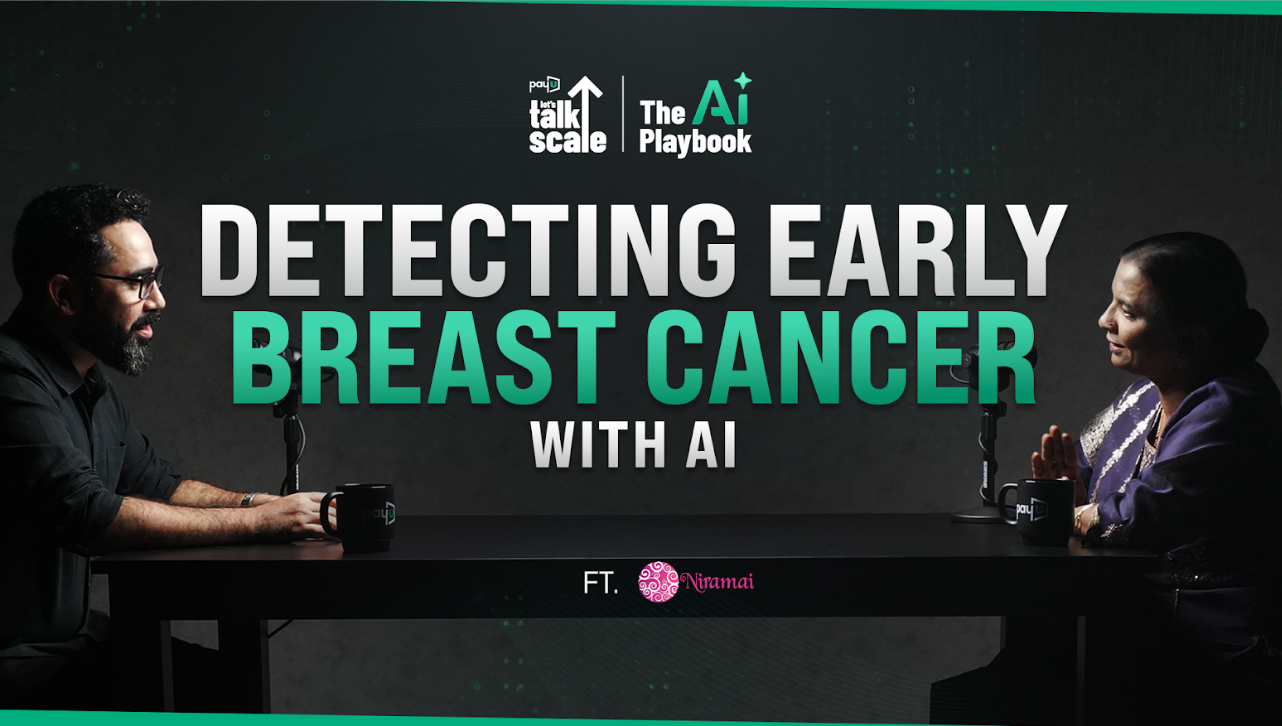
What does it take to build AI that doctors can trust?
Dr. Geetha Manjunath, Founder of Niramai, spent three decades in research and built a radiation-free, AI-powered approach to breast cancer screening.
Here’s what her journey reveals about building and scaling AI in healthcare.
THE BET
In 2016, Dr. Geetha was leading AI research at Xerox, managing over 100 researchers and engineers. She was also being considered for a bigger role.
But after losing her cousin sister to breast cancer at 42, she began looking for gaps in how the disease was detected, especially among younger women.
A colleague introduced her to thermal imaging research. She started exploring how AI could make it useful for breast cancer screening, working on the idea at night while keeping her job.
She knew she would regret not trying. So, she left Xerox, gave herself two years to make the idea work and started Niramai on 1 January 2017.
THE PROOF
About 10 months after starting Niramai, the team held a screening camp with the Karnataka Cancer Society. Women kept queuing up for screenings and asked the team not to close the camp until everyone had been screened.
For Dr. Geetha, this was an important sign. The technology was showing promise, picking up risks that needed attention and women were willing to use it.
THE TURN
In the early days, the AI gave a risk score, but a radiologist had to review the images and prepare the report. This caused delays.
At one camp, two women had the same name. When the team received a report two days later, they could not tell which woman it belonged to.
This led Niramai to improve its system and introduce instant reports.
The system now gives results in three colours: red, yellow and green. The report is ready by the time a woman leaves the screening room. A high-risk result also allows the team to speak to her and her family right away.
A product must work in the real setting where people will use it, not just in a test environment.
THE SCALE LESSON
Niramai grew as both a product company and a screening service. To reach more women, it built partnerships.
For corporate camps, it works with screening providers and insurance companies. In rural areas, it partners with cancer societies, NGOs and government programmes. These partnerships can also help make screening free for women.
Group camps have helped bring in more participants. When women see others getting screened, they feel more comfortable joining in.
Dr. Geetha calls this finding the right B2B partners to make a B2B2C model work. The aim is to work with organizations that can take your product to the people who need it.
Reaching more people also meant finding a business model that worked for different customers.
THE BUSINESS MODEL
Niramai has built more than 25 machine learning algorithms. But different customers need different reports.
Hospitals may need detailed reports showing areas the AI has flagged for further attention. Screening camps may only need to know who is at high risk and should go for more tests.
So, Niramai created different report options, including triage reports, Thermalytix 180 and Thermalytix 360. Basic triage reports use fewer AI models, while detailed reports use more.
The pricing model changed too. Initially, customers paid per scan at the end of each month because they were not comfortable paying a large amount upfront.
Today, high-volume customers can buy an annual software license with unlimited scans. Those with lower volumes can buy prepaid packs of 100 or 500 scans. Hardware is charged separately.
They made sure they offer pricing that matches how different customers use products.
THE PLAYBOOK
Dr. Geetha’s journey offers the following lessons for AI founders:
Bring doctors in early: Speak to specialists while you are still building the product. Their feedback can help you make something that works in real healthcare settings.
Treat rejection as feedback: Experts may tell you the technology will not work. Find out why, address their concerns and use what you learn to improve the product. This can also help you build trust with other doctors.
Keep testing: Start with existing patient data. Then test with real patients, followed by studies in real-world settings. Let the people who will actually use the product run these screenings. Each step adds more checks, and the studies must continue even after the product is in use.
For Dr. Geetha, technology alone is not enough. Better outcomes come when technology and medical knowledge work together.
PAYMENTS THAT POWER GROWTH
As businesses grow, they need reliable payment infrastructure to make every transaction easy for their customers.
PayU Payment Gateway helps businesses accept 150+ payment modes, with industry-leading success rates, 99.98% uptime and seamless integration across web and app platforms.
Know more about PayU solutions
NO ONE WAY TO SCALE
Niramai’s journey shows that building healthcare AI takes more than getting the technology right. It takes doctor trust, real-world testing, the right partners and a business model that can support growth.
PayU powers growing businesses, so founders can focus on building what’s next.