

AI sovereignty in fintech – and the resilience blueprint to get there.
I’ve spent about a decade shipping software, and I’ve watched us make the same mistake with every new “essential” technology: we adopt it faster than we govern it. Cloud, payment rails, SaaS – we eventually wrap each in vendor risk frameworks, DR plans, and failover tests. AI is the newest thing we’ve quietly made mission-critical without doing any of that.
So let me say the quiet part out loud.
AI, Mission-Critical by Accident
Think about how much of a modern fintech already runs on AI. It onboards our merchants, verifies KYC documents, reads and extracts data from statements and certificates, screens compliance cases, assists risk investigations, and answers customer queries. These aren’t pilots or side projects anymore – they’re live systems doing real work in production every day. And most of that runs on a handful of globally concentrated model providers, under jurisdictions we don’t control
That gap breaks down into three risks:
1. Regulatory risk – export controls, regional access restrictions, shifting rules on commercial deployment.
2. Commercial risk – pricing, rate limits, and model retirement schedules, all set by someone else.
3. Availability risk – when the provider has an outage, so do you.
The answer isn’t “ditch frontier AI”
I am not suggesting you drop GPT, Claude, or Gemini. They’re genuinely the best tools for hard, cognitive work – complex reasoning, agentic workflows, long-context analysis. Keep them for exactly that.
But let’s be honest about our actual workload mix. A huge share of fintech AI isn’t cognitive, it’s operational: OCR on a PAN card, extracting fields from a GST certificate, classifying a document, summarizing a statement. Predictable inputs, business rules, repeatable patterns. That’s not a job that needs a frontier model – it’s a job that needs a reliable model, the one you control.
Tier 1 – Frontier Models: reasoning, research, agentic work.
Tier 2 – Self-hosted Open Source Models: OCR, extraction, classification, summarization, internal copilots.
A year or two ago, I would have hesitated to put an open source model in Tier 2 as the models weren’t accurate enough for regulated work. That has changed – compact open-source models now post real numbers on exactly the tasks that fill a fintech’s operational tier: for instance, Qwen-class models, score around 85 on OCRBench (reading scanned documents) and around 86 on document-understanding benchmarks. That’s good enough for production document workflows – and you can serve it on a single modest GPU with tooling like vLLM or TGI. In other words, the self-hosted models, the ones you can control are now a real option and not a compromise!
The economics are the fun part
Your CFO is going to love you the moment you tell that: past a certain volume, every request you move off the frontier model is PURE MARGIN.
Frontier model pricing scales linearly – every request costs you again. A self-hosted GPU node scales as a step function: roughly $1,000/month for an average single GPU setup, fixed, until you saturate it, then you add another node.
For your own use case, do the model-token pricing against your expected volumes. If that cost is already above what it takes to host the model yourself, self-hosting is the prudent call – and it only gets better as you scale. The savings zone widens fast, because frontier pricing can’t keep up with uncapped per-request fees no matter how hard it tries.
The part that vendors won’t put on a slide
Let me warn you, self-hosting isn’t a free lunch – it’s a trade.
You now own:
1. Uptime
2. Scaling
3. GPU ops
4. MLOps
5. Model lifecycle &
6. Security
And most importantly, you’re now accountable for the outputs. This is an engineering and governance capability, not a weekend cost-cutting hack. Go in with eyes open or don’t go in.
But for a regulated business, the upside is more than money:
1. Data residency and DPDP alignment,
2. PCI-DSS-friendly control over payment-adjacent data,
3. Real audit trails,
4. Actual model governance,
5. VPN-only, no public endpoints,
6. Encrypted in transit and at rest.
That’s the posture that sits very well with regulators.
AI sovereignty blueprint, in one breath
AI sovereignty blueprint consists of three layers with automated routing between them –
1. Primary: frontier provider for the hard stuff.
2. Secondary: second frontier path (multi-cloud – Bedrock, Vertex, Azure) so one endpoint dying doesn’t stop you.
3. Internal: self-hosted open source for high-volume operational work.
Route by complexity, cost, criticality, and policy – not by hand. Then do the thing everyone skips: test the failover like you test DR. An untested fallback is a decorative fallback.
The PayU AI Sovereignty Framework
At PayU, we built exactly this hybrid AI sovereignty setup – frontier models for the hard reasoning, a self-hosted open-source tier for the high-volume operational grind – and put it into a controlled environment we own end to end. None of this is theoretical for us.
What we tested it on – We pointed the self-hosted tier at the workloads that dominate our document volume: OCR and field extraction from onboarding paperwork – PAN cards, GST certificates, bank statements, invoices – plus KYC verification, document classification, and summarization for compliance review. These are high-volume, rule-driven, and repetitive: the sweet spot for a model you control rather than one you rent per request.
The infrastructure – The reference node is a single AWS g5.2xlarge – one NVIDIA A10G (24 GB VRAM), 8 vCPUs, 32 GB RAM – running an open-source model (Gemma-class) served through vLLM. It sits entirely in a private subnet with no public internet exposure, reachable only over corporate VPN. A FastAPI gateway fronts the model for authentication, rate limiting, routing, and audit logging; vLLM itself binds to localhost so the model endpoint is never directly exposed. Observability runs on CloudWatch and Grafana for infrastructure and Langfuse for request, token, and cost tracing. When demand grows, we scale horizontally by adding inference nodes behind the load balancer.
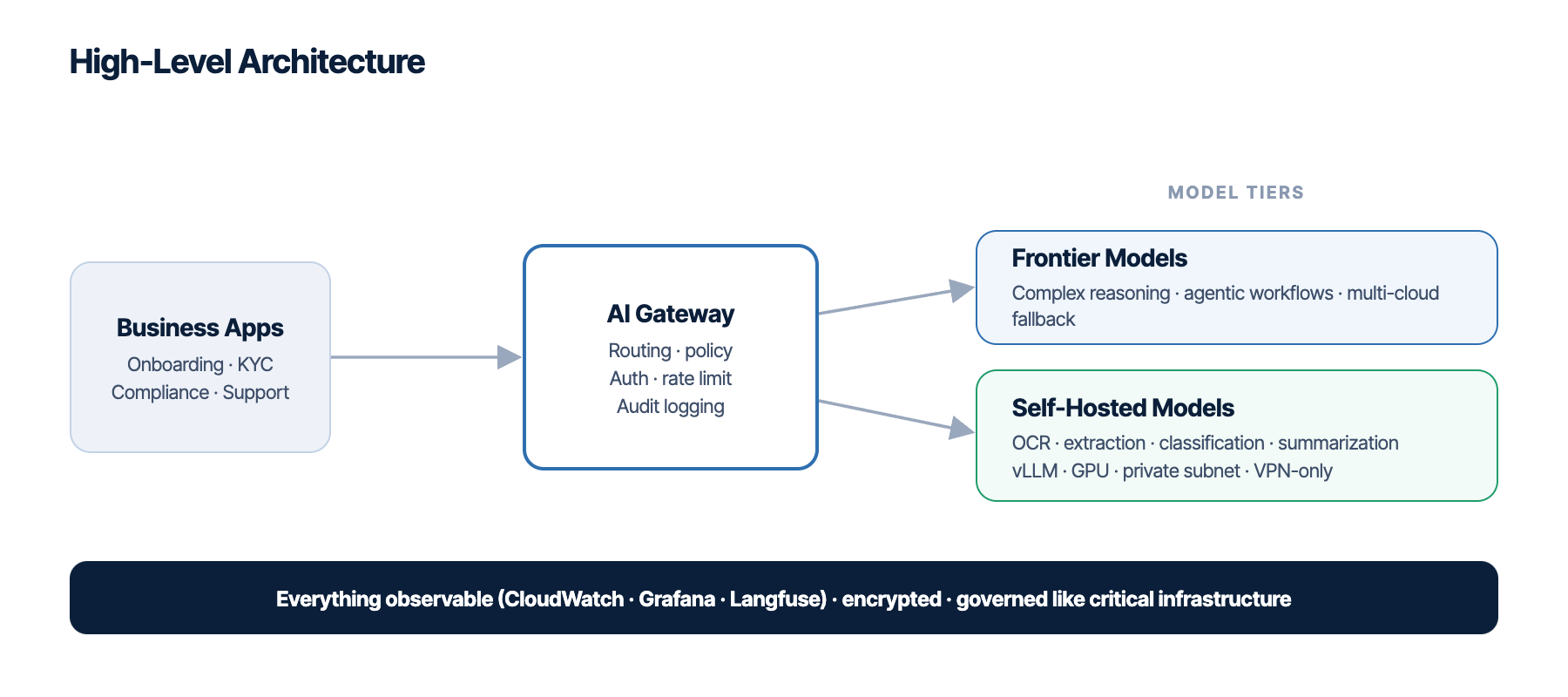
While internal benchmarking, a single GPU node processed a single-page document in roughly 8-12 seconds, which works out to be somewhere around 10,000-18,000 documents in a working day. All of this at a cost that barely registers against the equivalent frontier model bill.
Bottom Line
The future of enterprise AI isn’t frontier or open source. It’s the companies that combine both and govern AI the way they already govern cloud, payment networks, and critical vendors.